Isolating memory leaks with Chrome’s Allocation Timeline - LogRocket Blog
[
Advisory boards aren’t only for executives. Join the LogRocket Content Advisory Board today →
](https://lp.logrocket.com/blg/content-advisory-board-signup).metrics-banner {padding: 8px 0px; background: #764abc ;color: #ffffff;} .metrics-banner h6 {color: #ffffff;text-align:center; margin: 0px !important;} #metrics-embed {width: 65.5%; margin: 0px auto; display: block;} .mediumnavigation {padding: 0px 0px 8px 0px;} @media all and (max-width: 800px){ .mediumnavigation{box-shadow: none !important;} #metrics-embed {width: 90%;} .mainheading {padding: 4rem 0 1rem 0;} }

2017-11-01
955
#chrome
Renzo Lucioni
244
Nov 1, 2017 ⋅ 3 min read
Isolating memory leaks with Chrome’s Allocation Timeline

Renzo Lucioni Software Engineer @ LogRocket

Introducing Galileo AI
LogRocket’s Galileo AI watches every session, surfacing impactful user struggle and key behavior patterns.
const threshold = 2000; const isMobile = window.matchMedia("(max-width: 1280px)").matches; window.addEventListener('scroll', (event) => { if (isMobile) { return; } const gutter = document.querySelector(".plug-gutter"); // show it if it is hidden and we have scrolled past the threshold if (window.scrollY > threshold && !gutter.classList.contains("show")) { gutter.classList.add("show"); window.toggleToc(true); } // hide it if we scroll back above the threshold if (window.scrollY < threshold && gutter.classList.contains("show")) { gutter.classList.remove("show"); window.toggleToc(false); } });
.plug-dev-top--card { border: 2px solid rgba(118, 74, 188, 0.2); border-radius: 8px; background-color: #491d90; justify-content: space-between; align-items: center; padding: 16px; font-family: 'Proxima Nova', sans-serif; display:flex; gap: 1rem; cursor: pointer; } .plug-dev-top--logo { width: 48px; height: 48px; border-radius: 50%; } .plug-dev-top--blurb { h2 { font-weight: 800; font-size: 22px; line-height: 22px; color: #fff; width: 70%; margin: 0 0 5px 0; } h3 { font-weight: 900; font-size: 13px; line-height: 13px; letter-spacing: 0.1em; color: #fff; opacity: 0.5; white-space: nowrap; margin: 0; } } .plug-dev-top--cta { background-color: #fff; color: #764abc; border: none; border-radius: 4px; padding: 10px; font-size: 16px; font-weight: 800; font-family: 'Proxima Nova', sans-serif; text-decoration: none; width: 25%; text-align: center; &:hover { text-decoration: none; color: #a58ec8; } } .plug-dev-top--asset { position: relative; height: 400px; overflow: hidden; transition: all 0.3s ease; margin-top: 30px; &.lr-hidden { height: 0; margin: 0; } }

See how LogRocket's Galileo AI surfaces the most severe issues for you
No signup required
Check it out
const wistiaIframe = document.querySelector("#galileo-wistia-iframe"); wistiaIframe.addEventListener('load', () => { const player = wistiaIframe.wistiaApi; window.document.querySelector(".plug-dev-top").addEventListener('click', () => { const videoContainer = window.document.querySelector(".plug-dev-top--asset"); videoContainer.classList.toggle('lr-hidden'); if (videoContainer.classList.contains("lr-hidden")) { player.pause(); } else { player.play(); } }); });
When memory used by your program isn’t needed anymore, it’s supposed to be returned to the pool of free memory available to your operating system so that it can be reused. When your program doesn’t release this unused memory, you have what’s called a “memory leak” on your hands. Memory leaks can slow down your app and may eventually cause it to crash. They’re a common cause of performance issues in complex JavaScript apps.
Tracking down the root cause of a memory leak can be difficult. I’ve learned this the hard way at LogRocket while working to improve the performance and memory usage of our JavaScript SDK.
JavaScript is a garbage collected language. It will automatically attempt to free memory that isn’t being referred to by your program anymore. When memory can’t be freed, it means you’ve kept a reference to it somewhere in your code. These unwanted references are often subtle. Finding them by reading through your code can take hours.
Fortunately, there are better ways of approaching this problem. In particular, Chrome’s Allocation Timeline is a great tool for isolating and investigating memory leaks in your app.
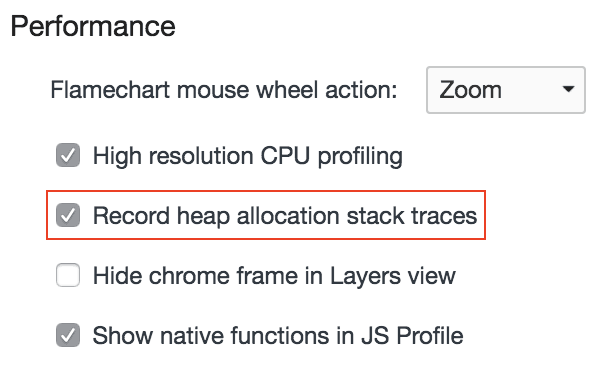
The Allocation Timeline will show you stack traces that can help you identify which part of your code is responsible for allocating particular objects. To use this feature, you need to enable a DevTools setting that is disabled by default. Open your DevTools settings, find the Performance section, and check “Record heap allocation stack traces.”


With that out of the way, let’s run through our example. We’ll work with the following page:
<!doctype html>
<html lang="en">
<head>
  <meta charset="UTF-8">
  <title>Leak</title>
</head>
<body>
  <button id="allocate">Allocate</button>
  <button id="release">Release</button>


  const allocate = document.getElementById("allocate");
  const release = document.getElementById("release");
  let strings = [];
  let interval;

  randomInteger = (min, max) => {
    // Min is inclusive, max is exclusive.
    min = Math.ceil(min);
    max = Math.floor(max);

    return Math.floor(Math.random() * (max - min)) + min;
  }

  storeString = (size) => {
    const s = new Array(size).join('s')
    strings.push(s);
  }

  leak = () => {
    // Allocate 1-3 MB.
    const size = randomInteger(1e6, 3e6);
    storeString(size);
  }

  allocate.onclick = () => {
    interval = setInterval(leak, 500);
  };

  release.onclick = () => {
    clearInterval(interval);
    strings = [];
  };

</body>
</html>
Here’s a version you can play with in your browser. When the “Allocate” button is clicked, the script on the page repeatedly allocates 1–3 MB of memory with which to store a string. References to these strings accumulate in the strings array until the “Release” button is clicked.
Open Chrome’s Task Manager and let the script run for several seconds. You should see the page consume an increasing amount of memory.

Keeping references to the strings we’re creating in an array simulates what happens during a memory leak by preventing JavaScript’s garbage collector from cleaning them up. The memory used to store each string is never released, causing our script’s memory usage to climb.
Now pretend we don’t already know the cause of this elevated memory usage. The Allocation Timeline can help us find the source of our leak (i.e., what’s using the memory that can’t be freed). To use it, select “Record allocation timeline,” located under the DevTools’ Memory tab.

Click the “Start” button to run the profiler, then click the “Allocate” button on our example page. You’ll see blue bars appear on the timeline.

Blue bars represent allocated memory that hasn’t been freed. If you click the “Release” button, the blue bars become gray bars.

Gray bars represent previously allocated memory that has been freed. Stop the profiler using the circle in the upper left.
Blue bars that remain on the allocation timeline when you stop a recording indicate potential memory leaks. To explore this case, re-run the profiler, click the “Allocate” button, then stop the profiler before clicking the “Release” button. You should be left with a timeline full of blue bars. Narrow your focus to a single blue bar by zooming in.

This limits the “Constructor” list to objects allocated in the highlighted span. In this case, we see that 2.8 MB worth of strings were allocated in this time span. (To learn more about the difference between shallow size and retained size, see the Memory Terminology section of the DevTools docs.)
Expanding the entry for the (string) constructor reveals that a single 2.8 MB string was allocated here. We can see the string itself, and by opening the “Allocation stack” tab, we can see a stack trace telling us exactly where this string was created.

In many cases, this stack trace can point you to the place in your code that needs fixing more quickly than if you were to attempt finding that spot without it.
Keep in mind that you can export allocation timeline snapshots by clicking the “Save” link in the sidebar. This is helpful if you find yourself profiling an especially busy or leaky app, in particular one that’s prone to crashing. This can slow down the DevTools to the point that they’re unusable, or in the case of a crash, cause you to lose your timeline altogether.
Instead of letting the app continue to run while you frantically inspect the timeline, save a snapshot, close the tab in which the app is running, take a deep breath, open a new tab, open the DevTools, then load your saved snapshot.
Memory leaks happen from time to time. The next time you encounter one, remember that the Allocation Timeline is your friend.
[

](https://lp.logrocket.com/blg/learn-more)
[#replay-signup { margin-block: 1rem; display: flex; gap: 0.5rem; flex-direction: column; align-items: center; border: 1px solid #E6DFF6; border-radius: 16px; padding: 0.5rem 2rem; background-color: #F4F0FB; font-family: 'Proxima Nova', sans-serif; font-size: 0.95rem; h3 { margin: 0; font-weight: bold; } p { max-inline-size: 65ch; } .replay-signup-form-wrapper { width: 60%; } .nf-before-form-content { display: none; } input.nf-element[type="submit"] { background-color: #764abc; color: #fff; border-radius: 8px; padding-block: 10px; height: unset; width: 100%; display: block; } .nf-response-msg { font-size: 1.2rem; text-align: center; } }
🚀 Sign up for The Replay newsletter
](https://lp.logrocket.com/blg/learn-more)
The Replay is a weekly newsletter for dev and engineering leaders.
Delivered once a week, it's your curated guide to the most important conversations around frontend dev, emerging AI tools, and the state of modern software.
Notice: JavaScript is required for this content.
var formDisplay=1;var nfForms=nfForms||[];var form=[];form.id='48';form.settings={"objectType":"Form Setting","editActive":true,"title":"Replay Newsletter Signup","show_title":0,"allow_public_link":0,"embed_form":"","clear_complete":1,"hide_complete":1,"default_label_pos":"above","wrapper_class":"","element_class":"","form_title_heading_level":"3","key":"","add_submit":0,"changeEmailErrorMsg":"Please enter a valid email address!","changeDateErrorMsg":"Please enter a valid date!","confirmFieldErrorMsg":"These fields must match!","fieldNumberNumMinError":"Number Min Error","fieldNumberNumMaxError":"Number Max Error","fieldNumberIncrementBy":"Please increment by ","formErrorsCorrectErrors":"Please correct errors before submitting this form.","validateRequiredField":"This is a required field.","honeypotHoneypotError":"Honeypot Error","fieldsMarkedRequired":"Fields marked with an *<\/span> are required","currency":"","unique_field_error":"A form with this value has already been submitted.","logged_in":false,"not_logged_in_msg":"","sub_limit_msg":"The form has reached its submission limit.","calculations":[],"conditions":[],"mp_breadcrumb":1,"mp_progress_bar":1,"mp_display_titles":0,"formContentData":[{"formContentData":["email","submit_1760469924554"],"order":0,"type":"part","clean":true,"title":"Part Title","key":"hzyqqobd"}],"objectDomain":"display","drawerDisabled":false,"ninjaForms":"Ninja Forms","fieldTextareaRTEInsertLink":"Insert Link","fieldTextareaRTEInsertMedia":"Insert Media","fieldTextareaRTESelectAFile":"Select a file","formHoneypot":"If you are a human seeing this field, please leave it empty.","fileUploadOldCodeFileUploadInProgress":"File Upload in Progress.","fileUploadOldCodeFileUpload":"FILE UPLOAD","currencySymbol":"$","thousands_sep":",","decimal_point":".","siteLocale":"en_US","dateFormat":"m\/d\/Y","startOfWeek":"1","of":"of","previousMonth":"Previous Month","nextMonth":"Next Month","months":["January","February","March","April","May","June","July","August","September","October","November","December"],"monthsShort":["Jan","Feb","Mar","Apr","May","Jun","Jul","Aug","Sep","Oct","Nov","Dec"],"weekdays":["Sunday","Monday","Tuesday","Wednesday","Thursday","Friday","Saturday"],"weekdaysShort":["Sun","Mon","Tue","Wed","Thu","Fri","Sat"],"weekdaysMin":["Su","Mo","Tu","We","Th","Fr","Sa"],"recaptchaConsentMissing":"reCaptcha validation couldn't load.","recaptchaMissingCookie":"reCaptcha v3 validation couldn't load the cookie needed to submit the form.","recaptchaConsentEvent":"Accept reCaptcha cookies before sending the form.","currency_symbol":"","beforeForm":"","beforeFields":"","afterFields":"","afterForm":""};form.fields=[{"objectType":"Field","objectDomain":"fields","editActive":false,"order":999,"idAttribute":"id","type":"email","label":"Email","key":"email","label_pos":"hidden","required":1,"default":"","placeholder":"Email","container_class":"","element_class":"","admin_label":"","help_text":"","custom_name_attribute":"email","personally_identifiable":1,"value":"","manual_key":true,"drawerDisabled":false,"id":401,"beforeField":"","afterField":"","parentType":"email","element_templates":["email","input"],"old_classname":"","wrap_template":"wrap"},{"objectType":"Field","objectDomain":"fields","editActive":false,"order":999,"idAttribute":"id","type":"submit","label":"Submit","processing_label":"Submitting...","container_class":"","element_class":"","key":"submit_1760469924554","admin_label":"","drawerDisabled":false,"id":402,"beforeField":"","afterField":"","value":"","label_pos":"above","parentType":"textbox","element_templates":["submit","button","input"],"old_classname":"","wrap_template":"wrap-no-label"}];nfForms.push(form); {{{ data.renderProgressBar() }}} {{{ data.renderBreadcrumbs() }}} {{{ data.renderPartTitle() }}} {{{ data.title }}}
{{{ data.renderNextPrevious() }}} <# if ( data.showPrevious ) { #>
<# _.each( data.parts, function( part, index ) { #>
function registerNinjaFormsCallback() { if (!(window.nfRadio && window.lr_analytics)) { return; } window.nfRadio.channel("forms").on("submit:response", function(submission) { console.log(submission); if (submission.data.form_id !== "48") { return; } window.lr_analytics.track("blog-replay-newsletter-signup", { post: window.location.pathname, email: submission.data.fields_by_key?.email?.value, }); }); } registerNinjaFormsCallback();
Over 200k developers use LogRocket to create better digital experiences
 Learn more →
@media all and (max-width: 800px){ .tweet-embed-container {flex-direction: column !important;} .single-tweet, .embed-tweet-right {width: 100% !important;} } .embed-link {text-decoration: none;} .embed-link:hover {text-decoration: none;} .tweet-embed-container {border-radius: 20px; background: radial-gradient(79.69% 102.24% at 100% 100.11%, rgba(0, 0, 0, 0.2), rgba(0, 0, 0, 0)), radial-gradient(89.7% 115.09% at 3.43% 2.75%, rgba(255, 255, 255, 0.7), rgba(255, 255, 255, 0)), #764ABC; background-blend-mode: overlay, overlay, normal; box-shadow: 0 4px 0 #d5d5d5; width: auto; padding: 20px 15px; display: flex; flex-direction: row; justify-content: space-evenly; align-items: center; margin: 0 auto; gap: 3%; } .single-tweet {width: 50%;} .single-tweet img {max-width: 100%;height: auto; border-radius:7px;} .embed-tweet-right {width: 46%;} .embed-tweet-right h2 {font-family: 'Avenir'; font-style: normal; font-weight: 500; font-size: 16px; line-height: 28px; color: #FFFFFF;} .embed-btn { display: flex; flex-direction: row; justify-content: left; width: 170px; gap: 5px; align-items: center; padding: 0px 10px; font-family: 'Avenir'; font-style: normal; font-weight: 900; font-size: 16px; line-height: 16px; color: #764ABC; height: 48px; /* White */ background: #FFFFFF; mix-blend-mode: normal; box-shadow: 0px 24px 30px rgba(0, 0, 0, 0.11); border-radius: 80px; border: none; }
.plug-cta-button { display: block; margin: 0 auto; width: 250px; height: 55px; background-color: #764abc; border-radius: 8px; color: #fff !important; font-family: proxima-nova, sans-serif; font-size: 16px; font-weight: 800; text-decoration: none; text-align: center; line-height: 55px } #plug-tabs > ul { display: flex; border-bottom: 1px solid gray; list-style: none; padding: 0; } #plug-tabs > ul li a, #plug-tabs > ul li a:active, #plug-tabs > ul li a:hover { display: block; padding: 0.25rem 1rem; text-decoration: none; } #plug-tabs .ui-tabs-active { border-top-right-radius: 8px; border-top-left-radius: 8px; border: 1px solid gray; border-bottom: 1px solid white; margin-bottom: -1px; } #plug-tabs pre { margin: 0 0 1rem 0; } window.addEventListener('load', function() { jQuery("#plug-tabs").tabs(); });
Get set up with LogRocket's modern error tracking in minutes:
- Visit https://logrocket.com/signup/ to get an app ID
Install LogRocket via npm or script tag.
LogRocket.init()must be called client-side, not server-side$ npm i --save logrocket
// Code:
import LogRocket from 'logrocket'; LogRocket.init('app/id');
// Add to your HTML:
- (Optional) Install plugins for deeper integrations with your stack:
- Redux middleware
- NgRx middleware
- Vuex plugin
.share-icon.share-twitter span:first-child { background-image: url("https://blog.logrocket.com/wp-content/themes/logrocket/assets/svgs/share-twitter.svg"); } .share-icon.share-reddit span:first-child { background-image: url("https://blog.logrocket.com/wp-content/themes/logrocket/assets/svgs/share-reddit.svg"); } .share-icon.share-linkedin span:first-child { background-image: url("https://blog.logrocket.com/wp-content/themes/logrocket/assets/svgs/share-linkedin.svg"); } .share-icon.share-facebook span:first-child { background-image: url("https://blog.logrocket.com/wp-content/themes/logrocket/assets/svgs/share-facebook.svg"); }


Stop guessing about your digital experience with LogRocket
[
Get started for free
](https://lp.logrocket.com/blg/signup)
@media all and (max-width: 750px) { .footer-cta-logo-container {display:none !important;} .footer-cta-container h2 {width: 90% !important; padding-top: 50px !important;} .footer-cta-button {width: 40% !important;} } .footer-cta-container {border-radius: 20px;background: linear-gradient(90.32deg, #8F00FF 0.28%, rgba(143, 0, 255, 0) 99.72%), #764ABC; box-shadow: 0px 64px 74px 0px #764ABC40; padding-bottom: 30px; width: 95%; margin: 0 auto 60px auto; position: relative; margin-top: 3rem; } .footer-cta-tr {position: absolute; top: 30px; right: 30px; } .footer-cta-bl {position: absolute; bottom: 30px; left: 30px; } .footer-cta-bl {} .footer-cta-logo-container { width: 20%; padding: 10px 15px; display:block; margin: 0 auto; position: relative; background: #fafafa; border-radius: 0 0 20px 20px; } .footer-cta-logo-container::before { content: ""; position: absolute; top: 0px; height: 50px; left: -25px; width: 25px; border-top-right-radius: 25px; box-shadow: 0 -25px 0 0 #fafafa; } .footer-cta-logo-container::after { content: ""; position: absolute; top: 0px; height: 50px; right: -25px; width: 25px; border-top-left-radius: 25px; box-shadow: 0 -25px 0 0 #fafafa; } .footer-cta-container h2 {color: #ffffff; text-align: center; width: 70%; position: relative; margin: 40px auto;} .footer-cta-container a {text-decoration: none;} .footer-cta-logo-container img {display: block; margin: 0 auto; padding: 10px; max-width: 150px;} .footer-cta-br {position: absolute; left: 5px; bottom: 5px;} .footer-cta-button {padding: 10px 20px; border: 1px solid #ffffff; width: 20%; border-radius: 20px; color: #ffffff; position: relative; display:block; margin: 0 auto 20px auto; text-align: center; text-decoration: none;}
Recent posts:
[

Should you bet on Valdi instead of React Native?
](https://blog.logrocket.com/valdi-instead-react-native/)
Valdi skips the JavaScript runtime by compiling TypeScript to native views. Learn how it compares to React Native’s new architecture and when the trade-off makes sense.

Dec 30, 2025 ⋅ 7 min read
[

The 8 trends that will define web development in 2026
](https://blog.logrocket.com/8-trends-web-dev-2026/)
What trends will define web development in 2026? Check out the eight most important trends of the year, from AI-first development to TypeScript’s takeover.

Dec 30, 2025 ⋅ 6 min read
[

AI-first debugging: Tools and techniques for faster root cause analysis
](https://blog.logrocket.com/ai-debugging/)
AI-first debugging augments traditional debugging with log clustering, pattern recognition, and faster root cause analysis. Learn where AI helps, where it fails, and how to use it safely in production.

Dec 29, 2025 ⋅ 6 min read
[

Container queries in 2026: Powerful, but not a silver bullet
](https://blog.logrocket.com/container-queries-2026/)
Container queries let components respond to their own layout context instead of the viewport. This article explores how they work and where they fit alongside media queries.

Dec 26, 2025 ⋅ 12 min read
#comments .comment .reply::after { background-image: url("https://blog.logrocket.com/wp-content/themes/logrocket/assets/svgs/reply.svg"); background-repeat: no-repeat; }
Leave a ReplyCancel reply
document.addEventListener('DOMContentLoaded', function () { var commentForms = document.getElementsByClassName('jetpack_remote_comment'); for (var i = 0; i < commentForms.length; i++) { commentForms[i].allowTransparency = false; commentForms[i].scrolling = 'no'; } });
{"prefetch":[{"source":"document","where":{"and":[{"href_matches":"/*"},{"not":{"href_matches":["/wp-*.php","/wp-admin/*","/wp-content/uploads/*","/wp-content/*","/wp-content/plugins/*","/wp-content/themes/logrocket/*","/*\\?(.+)"]}},{"not":{"selector_matches":"a[rel~=\"nofollow\"]"}},{"not":{"selector_matches":".no-prefetch, .no-prefetch a"}}]},"eagerness":"conservative"}]}
Would you be interested in joining LogRocket's developer community?
Yea No Thanks
Join LogRocket’s Content Advisory Board. You’ll help inform the type of content we create and get access to exclusive meetups, social accreditation, and swag.
var codePrettifyLoaderBaseUrl = "https:\/\/blog.logrocket.com\/wp-content\/plugins\/code-prettify\/prettify"; //# sourceURL=code-prettify-js-before var WPGroHo = {"my_hash":""}; //# sourceURL=wpgroho-js-extra _stq = window._stq || []; _stq.push([ "view", JSON.parse("{\"v\":\"ext\",\"blog\":\"217016018\",\"post\":\"244\",\"tz\":\"-5\",\"srv\":\"blog.logrocket.com\",\"hp\":\"vip\",\"j\":\"1:15.1.1\"}") ]); _stq.push([ "clickTrackerInit", "217016018", "244" ]); //# sourceURL=jetpack-stats-js-before {"baseUrl":"https://s.w.org/images/core/emoji/17.0.2/72x72/","ext":".png","svgUrl":"https://s.w.org/images/core/emoji/17.0.2/svg/","svgExt":".svg","source":{"concatemoji":"https://blog.logrocket.com/wp-includes/js/wp-emoji-release.min.js?ver=6.9"}} /*! This file is auto-generated */ const a=JSON.parse(document.getElementById("wp-emoji-settings").textContent),o=(window._wpemojiSettings=a,"wpEmojiSettingsSupports"),s=["flag","emoji"];function i(e){try{var t={supportTests:e,timestamp:(new Date).valueOf()};sessionStorage.setItem(o,JSON.stringify(t))}catch(e){}}function c(e,t,n){e.clearRect(0,0,e.canvas.width,e.canvas.height),e.fillText(t,0,0);t=new Uint32Array(e.getImageData(0,0,e.canvas.width,e.canvas.height).data);e.clearRect(0,0,e.canvas.width,e.canvas.height),e.fillText(n,0,0);const a=new Uint32Array(e.getImageData(0,0,e.canvas.width,e.canvas.height).data);return t.every((e,t)=>e===a[t])}function p(e,t){e.clearRect(0,0,e.canvas.width,e.canvas.height),e.fillText(t,0,0);var n=e.getImageData(16,16,1,1);for(let e=0;e{s[e]=t(o,e,n,a)}),s}function r(e){var t=document.createElement("script");t.src=e,t.defer=!0,document.head.appendChild(t)}a.supports={everything:!0,everythingExceptFlag:!0},new Promise(t=>{let n=function(){try{var e=JSON.parse(sessionStorage.getItem(o));if("object"==typeof e&&"number"==typeof e.timestamp&&(new Date).valueOf(){i(n=e.data),r.terminate(),t(n)})}catch(e){}i(n=f(s,u,c,p))}t(n)}).then(e=>{for(const n in e)a.supports[n]=e[n],a.supports.everything=a.supports.everything&&a.supports[n],"flag"!==n&&(a.supports.everythingExceptFlag=a.supports.everythingExceptFlag&&a.supports[n]);var t;a.supports.everythingExceptFlag=a.supports.everythingExceptFlag&&!a.supports.flag,a.supports.everything||((t=a.source||{}).concatemoji?r(t.concatemoji):t.wpemoji&&t.twemoji&&(r(t.twemoji),r(t.wpemoji)))}); //# sourceURL=https://blog.logrocket.com/wp-includes/js/wp-emoji-loader.min.js (function () { const iframe = document.getElementById( 'jetpack_remote_comment' ); const watchReply = function() { // Check addComment._Jetpack_moveForm to make sure we don't monkey-patch twice. if ( 'undefined' !== typeof addComment && ! addComment._Jetpack_moveForm ) { // Cache the Core function. addComment._Jetpack_moveForm = addComment.moveForm; const commentParent = document.getElementById( 'comment_parent' ); const cancel = document.getElementById( 'cancel-comment-reply-link' ); function tellFrameNewParent ( commentParentValue ) { const url = new URL( iframe.src ); if ( commentParentValue ) { url.searchParams.set( 'replytocom', commentParentValue ) } else { url.searchParams.delete( 'replytocom' ); } if( iframe.src !== url.href ) { iframe.src = url.href; } }; cancel.addEventListener( 'click', function () { tellFrameNewParent( false ); } ); addComment.moveForm = function ( _, parentId ) { tellFrameNewParent( parentId ); return addComment._Jetpack_moveForm.apply( null, arguments ); }; } } document.addEventListener( 'DOMContentLoaded', watchReply ); // In WP 6.4+, the script is loaded asynchronously, so we need to wait for it to load before we monkey-patch the functions it introduces. document.querySelector('#comment-reply-js')?.addEventListener( 'load', watchReply ); const commentIframes = document.getElementsByClassName('jetpack_remote_comment'); window.addEventListener('message', function(event) { if (event.origin !== 'https://jetpack.wordpress.com') { return; } if (!event?.data?.iframeUniqueId && !event?.data?.height) { return; } const eventDataUniqueId = event.data.iframeUniqueId; // Change height for the matching comment iframe for (let i = 0; i < commentIframes.length; i++) { const iframe = commentIframes[i]; const url = new URL(iframe.src); const iframeUniqueIdParam = url.searchParams.get('iframe_unique_id'); if (iframeUniqueIdParam == event.data.iframeUniqueId) { iframe.style.height = event.data.height + 'px'; return; } } }); })(); {{{ ( 1 == data.settings.show_title ) ? '' + data.settings.title + '' : '' }}}